 Back home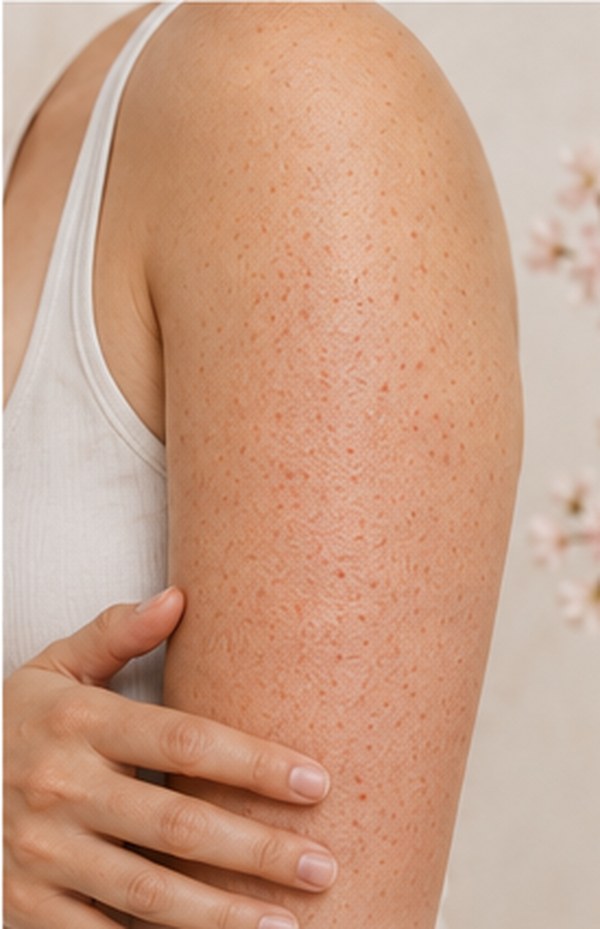
Keratosis pilaris (often called 'chicken skin') is one of the most common and most misunderstood skin concerns. It shows up as tiny, rough, sandpapery bumps — usually on the upper arms, thighs, cheeks or buttocks. The bumps are usually skin-coloured, pink or red, and they do not itch or hurt for most people. It is not contagious, not caused by poor hygiene and not acne, although it is easy to confuse with body breakouts.
KP is a build-up of keratin — the protein that makes up your skin's outer layer — around hair follicles. It tends to run in families, flare in winter or in dry climates, and often improves with age. You cannot permanently cure it, but you can make the texture dramatically softer with the right mix of mild exfoliation, hydration and barrier support.
What keratosis pilaris looks and feels like
- Tiny rough bumps that feel like goosebumps or sandpaper to the touch.
- Common on upper arms, outer thighs, cheeks in children, and sometimes the buttocks.
- Bumps may be skin-coloured, pink, red or brown, depending on your skin tone.
- Usually not painful or itchy, but can feel dry or irritated when over-exfoliated.
- Often worse in cold, dry weather and better in humid, warm climates.
The actives that actually help
AHAs — lactic acid and glycolic acid
Lactic acid is especially helpful for KP because it exfoliates and hydrates at the same time. Glycolic acid is a little stronger and works well on thicker body skin. Start with 2–3 nights a week and increase slowly if your skin tolerates it.
BHA — salicylic acid for stubborn bumps
Salicylic acid can travel into the follicle and dissolve the keratin plug from inside. It is helpful on oilier areas or when KP bumps look inflamed. Body washes or leave-on treatments with 0.5–2% salicylic acid work well.
Retinoids — slow and steady
Prescription retinoids like tretinoin can help severe KP, but they are often too irritating for sensitive areas. Over-the-counter retinol or retinal body treatments can support cell turnover when used cautiously and always buffered with moisturiser.
Barrier and soothing support
Because KP skin is often dry and easily irritated, barrier ingredients matter just as much as exfoliants. Ceramides, panthenol, allantoin, squalane and centella help keep the skin calm and comfortable while the actives do their work.
A simple body routine for keratosis pilaris
- In the shower, use a gentle, non-fragranced body wash — no harsh scrubbing mitts or loofahs.
- 2–3 nights a week, apply a lactic acid or glycolic acid body lotion to damp skin.
- Alternate with a salicylic acid body lotion if bumps are inflamed or stubborn.
- Every morning, apply a ceramide-rich moisturiser to lock in hydration.
- Be patient — visible softening usually takes 4–8 weeks of consistent use.
What to avoid
- Physical scrubs, pumice stones and aggressive exfoliation — they can tear the skin and make KP look redder.
- Very hot showers and stripping soaps — they dry out the skin and worsen the texture.
- Picking or squeezing the bumps — they are not blackheads and will not empty; picking causes marks.
- Fragranced products on KP areas if the skin is sensitive or easily irritated.
When to see a dermatologist
Most KP is harmless and can be managed at home. See a dermatologist if the bumps are very inflamed, itchy, painful, suddenly much worse, or leaving dark marks that won't fade. A dermatologist can prescribe stronger retinoids, exfoliating compounds or check whether it is actually KP or another condition.


