 Back home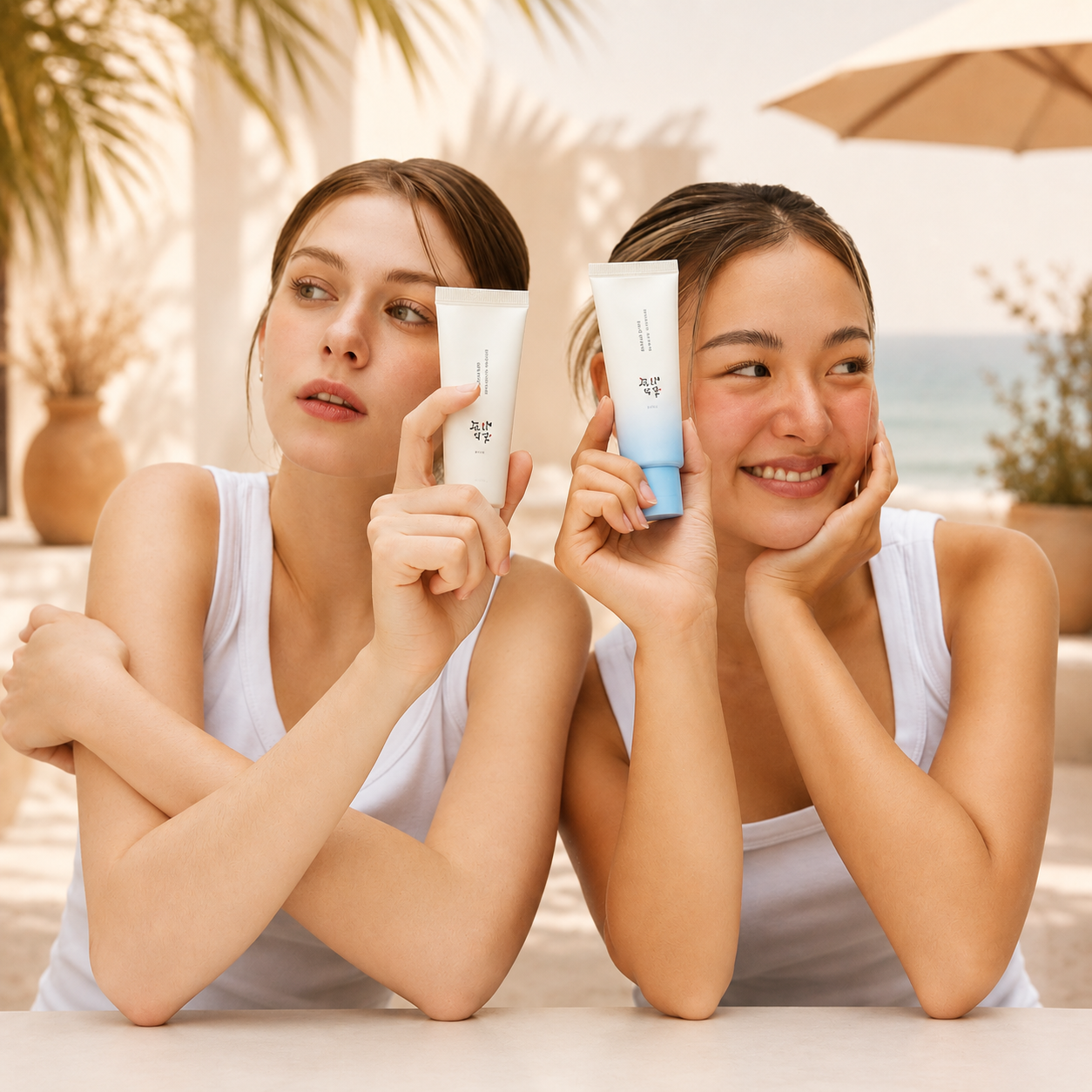
Sunscreen is the single most effective anti-ageing product you will ever own — up to 80% of visible facial ageing comes from UV exposure, not time. It also prevents pigmentation, protects your skincare investment (retinoids, vitamin C, acids all become photo-reactive without SPF), and lowers skin cancer risk. Korean sunscreens have reshaped the category worldwide: lightweight, invisible finishes, no white cast, and formulas that feel like skincare rather than a chore.
The types of sunscreen — chemical, mineral and hybrid
All sunscreens use UV filters — the difference is what kind. K-beauty has led the way in blending both worlds for the most elegant finish.
Chemical (organic) sunscreens
- Use filters like Uvinul A Plus, Tinosorb S/M, Octinoxate, Uvinul T 150 that absorb UV rays and convert them to heat.
- Feel lightweight, blend invisibly, no white cast — the reason K-beauty SPF feels so elegant.
- Modern Korean/European filters (Tinosorb, Uvinul) are photostable, non-irritating and offer broad UVA + UVB protection.
- Best for most skin types, deeper skin tones, and daily wear under makeup.
Mineral (physical / inorganic) sunscreens
- Use Zinc Oxide and/or Titanium Dioxide, which sit on the skin and both reflect and absorb UV.
- Excellent for sensitive, reactive, rosacea-prone or post-procedure skin.
- Traditionally leave a white cast — modern micronised versions are far better but still visible on deeper skin tones.
- Safe during pregnancy and for babies over 6 months.
Hybrid sunscreens
- Combine mineral and chemical filters for the best of both — lightweight feel with mineral gentleness.
- Very common in Korean formulas; often the best all-rounders for combination and normal skin.
SPF 30 vs SPF 50 — what the numbers really mean
- SPF 30 blocks about 97% of UVB rays.
- SPF 50 blocks about 98% of UVB rays.
- SPF 100 blocks about 99% — the difference beyond 50 is marginal.
- The jump from 30 → 50 sounds small on paper but matters in real life: most people apply only 25–50% of the recommended amount, so a higher SPF gives you a safety buffer.
- PA rating (UVA): PA+ = some protection, PA++ = moderate, PA+++ = high, PA++++ = very high. For daily use aim for PA+++ or PA++++.
For South African sun, daily driving and outdoor days: choose SPF 50 PA++++. It's the K-beauty standard for a reason.
Textures — pick what your skin will actually wear every day
The best sunscreen is the one you'll happily reapply. K-beauty makes so many textures because a sunscreen that feels heavy gets skipped.
- Fluid / essence sunscreens — watery, weightless, near-invisible finish. Ideal for oily, combination and layering under makeup.
- Milk / lotion sunscreens — light and slightly hydrating. Universal fit for normal, combination and slightly dry skin.
- Cream sunscreens — richer, more comforting, sometimes glowy. Best for dry, mature or winter skin.
- Gel sunscreens — cooling, watery, matte finish. Excellent for oily and acne-prone skin.
- Stick sunscreens — clean, no-hands top-ups over makeup, at the beach or on the go.
- Cushion / powder SPF — for reapplying over makeup without disturbing the base.
- Tinted / tone-up sunscreens — add a light wash of colour or radiance (see below).
The best sunscreen for your skin type
- Oily / acne-prone — fluid, gel or essence SPF; non-comedogenic, alcohol-light, matte finish (look for niacinamide or centella in the formula).
- Dry / mature — cream or milk SPF with hyaluronic acid, ceramides, panthenol; a glowy tone-up SPF works beautifully here.
- Combination — a milk or lightweight cream, or a hybrid fluid, sits well over most of the face.
- Sensitive / rosacea-prone / post-procedure — mineral or mineral-heavy hybrid, fragrance-free, with centella, madecassoside or heartleaf.
- Deeper skin tones — chemical or hybrid sunscreens with modern Korean filters (Tinosorb, Uvinul) — no white cast. Avoid heavy pure-mineral formulas unless they're specifically tone-adjusted.
- Pregnancy — mineral sunscreens (zinc oxide, titanium dioxide) are the safest choice.
- Kids — dedicated child-safe mineral formulas from 6 months up.
Tone-up sunscreens — the K-beauty glow secret
Tone-up sunscreens are one of Korea's cleverest inventions — an SPF that also gently brightens, blurs and adds a wash of radiance to your complexion. Think of them as a hybrid between sunscreen, primer and a whisper of skin tint. Some are lightly tinted with pink, lavender or beige pigments; others use light-diffusing minerals that visibly brighten.
How they work
- Use micronised zinc oxide, titanium dioxide or pearl pigments to reflect light and even out tone.
- Some are lightly tinted (pink, lavender, peach) to neutralise dullness or redness on wear.
- The 'tone-up' effect is instant — a soft, milky glow rather than heavy coverage.
Which skin tones tone-up sunscreens suit
- Very fair to light — most tone-up formulas were designed with this range in mind and give a natural glow with no obvious cast.
- Light to medium — usually work beautifully, especially lavender or pink-toned versions that counter sallowness.
- Medium to tan — choose warm-toned (peach, beige) tone-ups, or lightly-tinted BB-style SPFs; avoid heavy white or lavender tone-ups which can leave a grey or ashy cast.
- Deep and rich skin tones — traditional white / lavender tone-up sunscreens usually leave a visible cast and are best avoided. Look instead for tinted sunscreens with brown iron oxides (the tint that actually blends into deeper skin), or a clear high-SPF chemical/hybrid sunscreen paired with a foundation or skin tint that matches you.
How to use sunscreen properly
- Apply as the last step of your morning skincare, before makeup.
- Use two finger-lengths for face and neck — about 1/4 teaspoon. Most people under-apply and get half the protection.
- Wait 1–2 minutes for it to set before applying makeup.
- Reapply every 2 hours outdoors, after swimming, or after heavy sweating.
- Indoors near windows or driving? Reapply once around midday — UVA passes through glass.
- Cushion or stick SPF makes reapplying over makeup easy — no need to remove your base.
Common myths — and the real truth
- 'I don't need SPF indoors.' UVA passes through windows and screens emit blue light. If you're near a window most of the day, wear SPF.
- 'My foundation has SPF 15 — I'm covered.' You'd need to apply seven times more foundation than anyone does to get its labelled protection. Wear a real sunscreen underneath.
- 'My skin is dark, I don't burn.' Deeper skin still develops UV-driven pigmentation, ageing and skin cancer. SPF is universal.
- 'Sunscreen causes acne.' Old, heavy sunscreens sometimes did. Modern K-beauty SPFs are lightweight, non-comedogenic and often help acne heal by protecting post-blemish marks from darkening.
- 'Higher SPF = full-day protection.' No — reapplication is the only thing that keeps protection going through the day.
What to expect
- Immediately: fewer visible burns, less redness after outdoor days, a softer complexion.
- Within 4–8 weeks: post-blemish marks stop darkening; existing brightening actives (vitamin C, TXA, arbutin) start showing visible results.
- Within 6–12 months of consistent daily SPF: more even tone, softer fine lines, fewer new sun spots.
- Long-term: significantly slower visible ageing than skin left unprotected.
Browse the Litsy sunscreen collection — Korean formulas across every texture and finish, from weightless fluids to glowy tone-ups. The best skincare investment you'll make this year.


